

 1 month ago
Aerial footage shows floods on Nepal-Tibet border
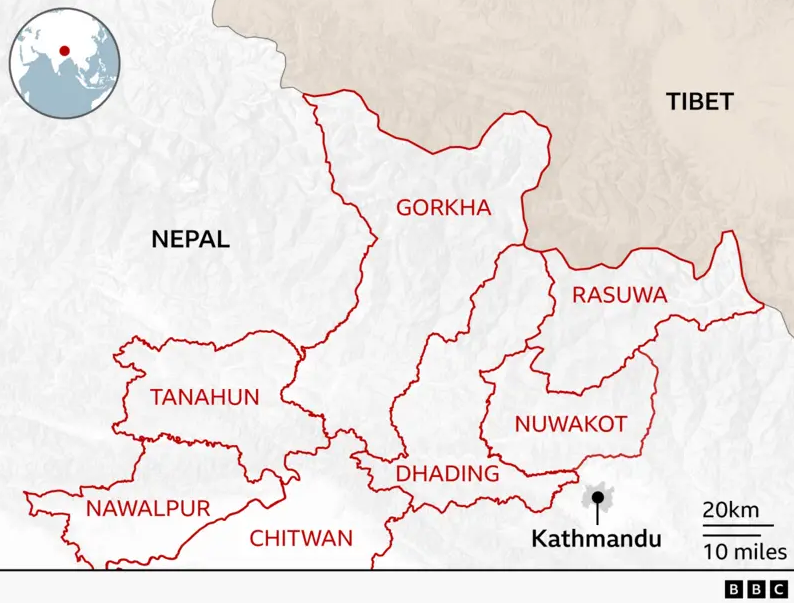
Dozens of Americans and Canadians are among hundreds of people who are missing following a deadly flash flood and mudslide near the Nepal-Tibet border, Nepali authorities say.
More than 150 people are so far known to have died, according to the authorities.
The US State Department said it was aware that Americans were impacted by Wednesday's floods but did not provide numbers.
It added that the US embassy in Nepal is working closely with local tour agencies and authorities to assist affected Americans, a spokesperson said.
Canada's foreign office said it was also monitoring developments and was ready to provide assistance if needed.
According to Nepal police, 579 tourists are missing - including 466 who are foreign nationals and from 28 different countries.
They include 54 people from the US, more than 100 from India, 33 from the UK and more than 100 from Nepal.
The State Department did not provide figures or additional details regarding the Americans affected for privacy reasons.
A further 24 Canadians are also missing, a Nepal Tourist Board spokesperson said. The BBC has contacted Canada's foreign office for confirmation.
State media in China, which controls Tibet, reported three dead and 265 missing there. CCTV from Tibet showed a wall of water and mud hitting buildings at a border crossing.
Initial reports from Nepal had suggested that an earthquake may have triggered the ice avalanche and landslide.
But the US Geological Survey, which studies earthquakes, has now said that further analysis indicates "that the seismic energy was instead generated by a landslide" by itself.
Landslides or avalanches can have various triggers. One possibility is that water - either from rainfall or melting ice - may have destabilised the ground or ice.
Climate change is known to be driving faster glacier melt in the Hindu Kush Himalaya region, but scientists say it is too soon to pinpoint its role in this specific event.
The flash flooding swept away entire communities. Roads and bridges worth more than 15bn Nepalese rupees (£72.18m, $98.33m) were damaged by the floods, a government official told BBC Nepali, citing initial estimates.
The US Embassy in Nepal said it remained in close contact with Nepali authorities.
"We are deeply saddened by the tragic loss of life and devastation caused by the Bhote Koshi flood that struck Rasuwa district and communities downstream," it said in a statement posted on social media.
"We extend our sincere condolences to the families and loved ones of those who lost their lives, and our thoughts are with all those affected by this disaster."
Nepal's President Ram Chandra Paudel has called upon the government, political parties, social organisations, all agencies including security forces, and the general public to intensify rescue and relief efforts.
"I urge everyone to remain vigilant and actively engage in necessary coordination and cooperation in the lower coastal areas," he said.
With additional reporting by Mark Poynting, climate and science journalist














 English (US) ·